Conquer Any Angle: The Beginner's Guide to Welding Positions
Think welding is just about running a bead on a flat table? Think again. The real world throws curves, corners, and ceilings at you, and if you can't weld out of position, you're stuck in beginner mode forever.
Mastering positions is what separates hobbyists from real welders who can tackle any project.
Flat Position (1G/1F) – Your Starting Line
This is where everyone starts, and for good reason. Gravity is your friend here, pulling the molten puddle down into the joint. You're welding on a flat surface, with the weld axis horizontal.
For groove welds (1G), you're filling a joint. For fillet welds (1F), you're making a T-joint or lap joint, still on a flat surface. Your torch or rod angle is crucial – usually a slight drag angle for MIG/stick, or a small push for TIG, aimed straight into the joint.
Horizontal Position (2G/2F) – Fighting Gravity
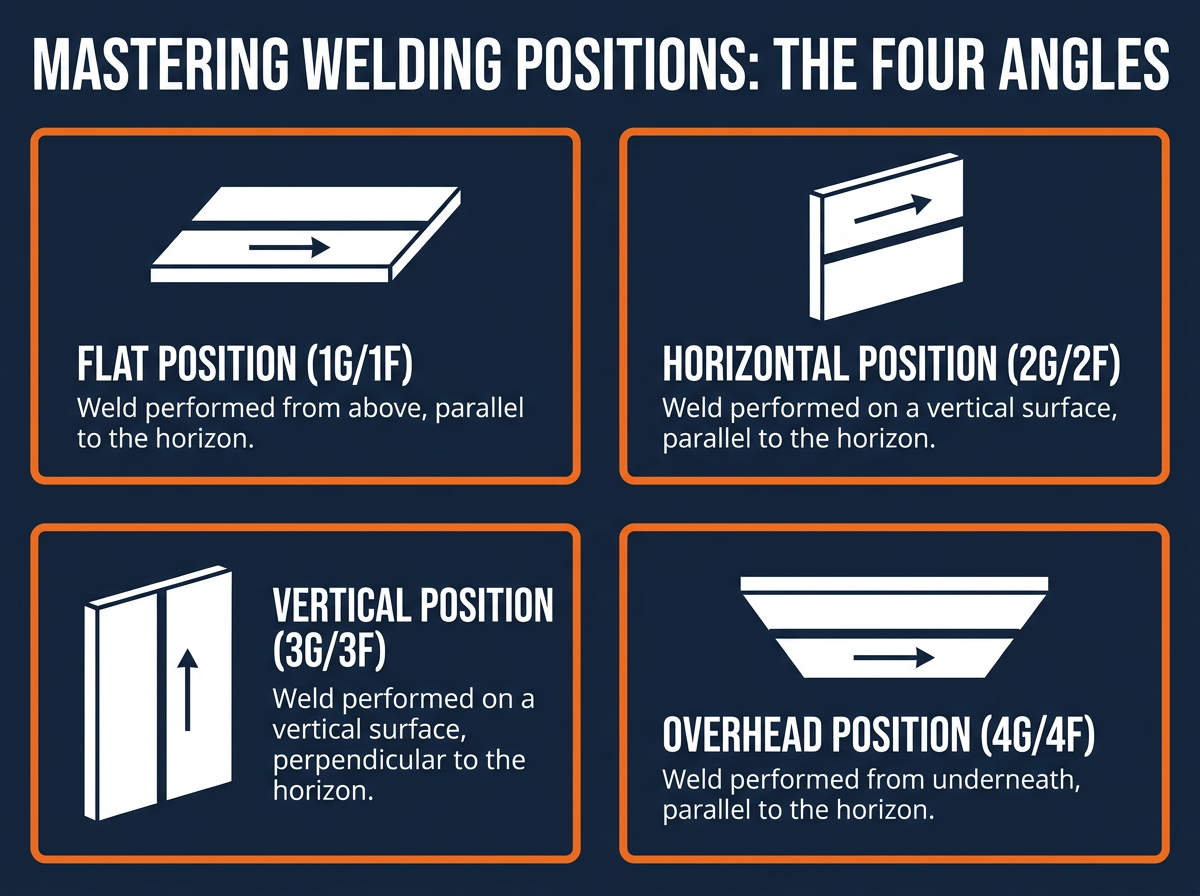
Now gravity starts to mess with you. In the horizontal position, the weld axis is horizontal, but the work piece is vertical. Imagine welding a shelf bracket to a wall, or a pipe running horizontally.
For groove welds (2G), you're welding across a vertical plate. For fillet welds (2F), you're welding a T-joint where the vertical plate is, well, vertical, and the horizontal plate is flat.
The key here is a slight upward angle on your torch or rod to counteract gravity pulling the puddle down. Keep your travel speed consistent; too slow and the puddle sags.
Vertical Position (3G/3F) – Up or Down?
This is where beginners really struggle. Welding vertical can be done either up (Vertical Up) or down (Vertical Down).
Vertical Up (VU) is generally stronger for structural work because it allows for better penetration and fill. Vertical Down (VD) is faster and often used for thin material or non-structural applications like sheet metal, as it reduces heat input.
In Vertical Up, you're fighting gravity hard. You'll need to use a tight arc and a specific weave pattern, like a Christmas tree or a Z-weave, letting the edges freeze slightly before adding more metal.
Aim slightly upwards, almost like you're "stacking" the weld metal. For stick welding, a 6010 or 6011 rod excels here. For MIG, drop your wire speed and increase your voltage slightly to maintain a tight arc.
For Vertical Down, gravity helps pull the puddle, but you need to move fast to avoid blowing through. A slight downward angle is key. This is often used for quick passes or when appearance on thin material is more critical than maximum strength.
Overhead Position (4G/4F) – The Ultimate Test
The overhead position is the toughest because gravity is actively trying to pull your molten metal right onto your head.
You're welding on the underside of a structure. Think of welding a beam in a ceiling, or the underside of a car chassis.
Just like vertical up, you need a tight arc and fast travel speed. Don't let the puddle get too big, or it will drip.
Keep a short stick out for MIG and TIG, and a very tight arc length for stick. Smaller weave patterns are your friend.
A steady hand and good body positioning are critical to maintain your arc and prevent fatigue.
Common Mistakes When Welding in Position
Ignoring Gravity's Pull: The biggest rookie mistake. You can't weld vertical or overhead like you weld flat. Adjust your angle, travel speed, and technique to fight or use gravity.
Too Much Heat/Too Slow Travel: This is a surefire way to get saggy, lumpy welds, especially in vertical and overhead. The puddle gets too big and just drips. Turn down your amperage or wire speed, and pick up your pace.
Poor Body Positioning: You can't be comfortable if you're straining. Get yourself into a stable, comfortable position. Use clamps, stands, or even your free hand (with a glove!) to brace yourself. Fatigue leads to shaky hands and ugly welds.
Wrong Rod/Wire Angle: Each position demands a specific torch or rod angle to direct the heat and puddle correctly. Experiment and feel how the puddle reacts to small angle changes.
Not Cleaning Your Metal: This isn't unique to positions, but it's amplified when you're fighting gravity. Dirty metal means an unstable arc and poor fusion, which you absolutely cannot afford when the puddle is already trying to fall out.
Mastering welding positions takes practice, plain and simple. Start flat, then move to horizontal, then vertical, and finally overhead. Don't rush it. Every bead you run, whether perfect or ugly, teaches you something.
Keep your head in the hood, dial in those settings, and trust your hands. Soon, no angle will be too challenging for you.
Quinn "The Welder" Morrissette
Join 30,000+ students learning to weld at home with my online course:
>>> Check out 1 Day Welder here
>>> Shop the 1 Day Welder Amazon Store