How to Beat Weld Spatter Stop Wasting Time Cleaning Messy Welds
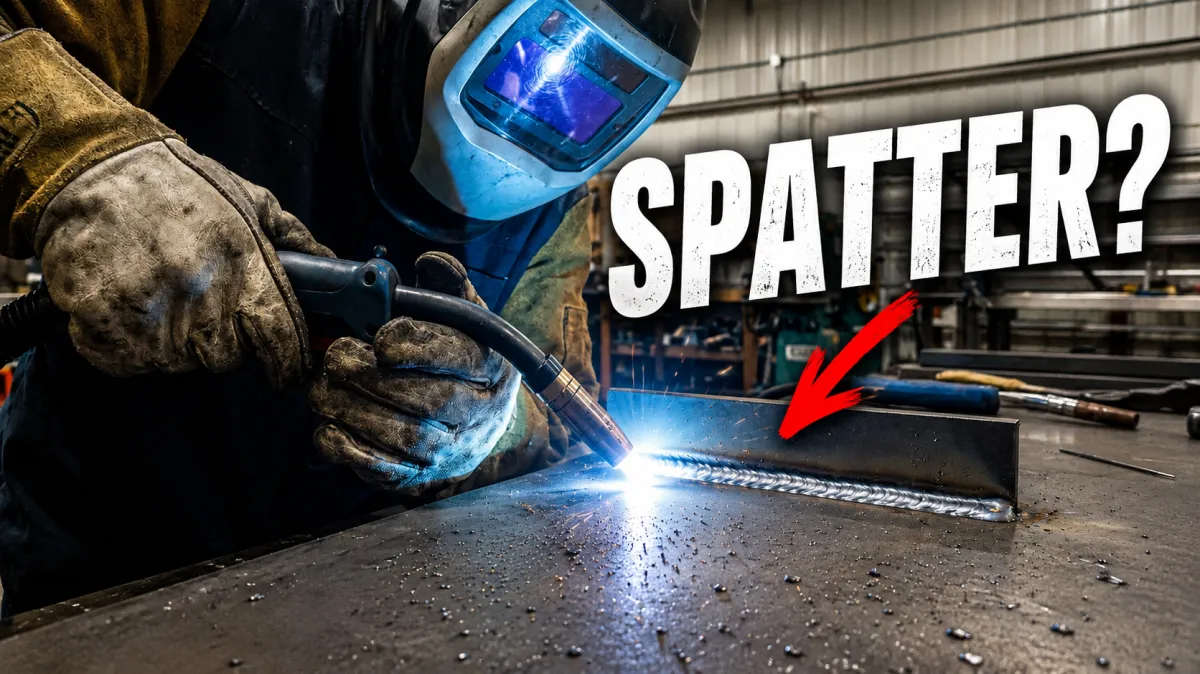
Your garage floor looks like a battleground of molten BBs after a MIG session.
That's spatter, and it's not just annoying to clean up – it's a giant flashing sign that something's off with your weld.
Spatter isn't just cosmetic. Those little metal balls are wasted material, and excessive spatter often means your arc isn't stable. An unstable arc leads to weak, ugly welds, and a whole lot of extra grinding and chipping you don't need.
Dialing In Your Settings: Voltage and Wire Speed
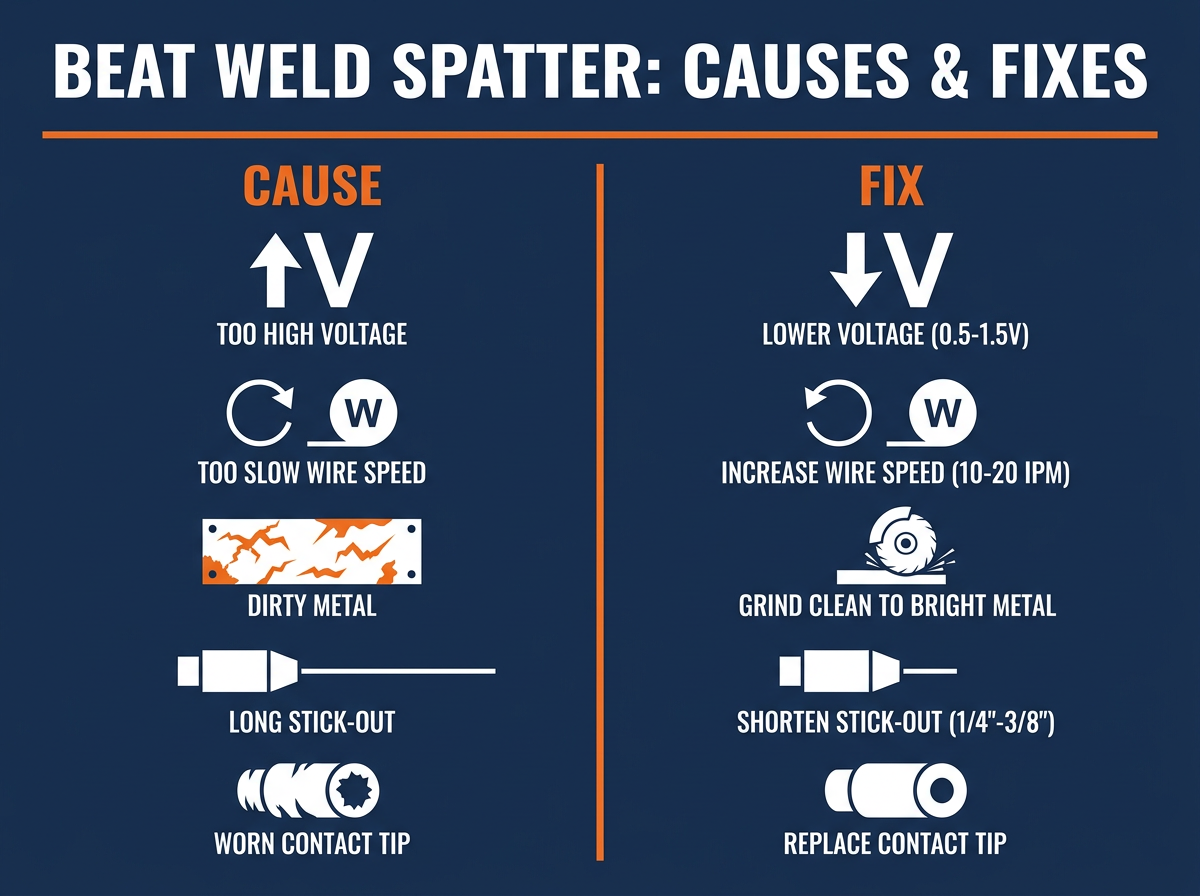
Too high voltage often throws more spatter than a fireworks display. If your arc sounds harsh, almost like bacon sizzling too violently, try dropping your voltage by 0.5 to 1.5 volts. You're looking for a smooth, consistent crackle, not an explosion.
Your wire speed needs to match that voltage. Too slow, and the wire burns back into the tip, creating a harsh arc and a shower of spatter. Too fast, and it can stub out into the puddle, pushing molten metal everywhere. Think about the "sweet spot" where the wire burns off cleanly right as it touches the puddle.
If your machine, like a higher-end Miller Multimatic or Lincoln Electric PowerMIG, has inductance control, play with it. Inductance affects the "softness" of your arc. Higher inductance can make the arc smoother and reduce spatter, especially when using 100% CO2 gas. Start with your machine's recommended base setting for the material thickness and gas, then adjust in small increments.
Master Your Technique: Stick-Out, Angle, and Travel Speed
Your "stick-out" – the length of welding wire extending from your contact tip – is crucial. Too long (more than about 3/8" for short-circuit MIG) and your wire isn't getting enough current before it hits the puddle. This leads to an erratic arc and a ton of spatter because the wire isn't melting consistently.
Keep your stick-out consistent, usually between 1/4" to 3/8" (6-10mm) for most MIG applications. If you're running a bigger machine or thicker wire, you might go a bit longer, but consistency is key. Practice maintaining that distance like you're holding a steady hand drawing a line.
Your travel angle also makes a difference. A slight push angle (10-15 degrees, with the gun leaning into the direction of travel) generally gives a smoother arc, better visibility, and less spatter than a drag angle. This is particularly true for thinner materials and short-circuit MIG.
Finally, your travel speed. Too slow, and you're just cooking the metal, creating a wide, convex bead with excessive heat input and often more spatter. Too fast, and you'll get a thin, ropey bead with poor penetration and potentially an unstable arc that throws spatter. Listen to the arc and watch the puddle: it should flow smoothly behind the arc, not pile up or lag too far behind.
Don't Skimp on Consumables: Tips, Nozzles, and Gas Flow
A worn-out contact tip is a spatter magnet, plain and simple. Over time, the hole gets oval-shaped and expands from arc heat and wire friction. This leads to poor electrical contact with the wire, causing an erratic arc, inconsistent current transfer, and a shower of molten metal. Swap it out for a fresh Lincoln Electric, Miller, or Hobart tip regularly – they're cheap insurance.
Keep your nozzle clean. Spatter buildup inside can block your shielding gas from reaching the weld pool effectively. This exposes your weld to atmospheric contaminants, leading to porosity, more spatter, and a generally ugly weld. Use anti-spatter spray or dip your nozzle in anti-spatter gel every few minutes, especially during longer runs.
Your shielding gas and its flow rate are absolutely critical. Too little gas, and you're essentially welding in open air, inviting contaminants and causing excessive spatter. Too much gas, and it can create turbulence, pulling in ambient air and also leading to issues.
For most MIG welding, 75% Argon/25% CO2 mix is the standard. Aim for a flow rate of 20-25 CFH (Cubic Feet per Hour). If you're running straight 100% CO2, expect naturally more spatter due to its "harsher" arc characteristics, but good settings and technique can still minimize it significantly.
Clean Metal, Clean Welds: The Unsung Hero
This one sounds obvious, but so many beginners skip it, then wonder why their welds look like garbage. Rust, paint, oil, grease, or even heavy mill scale on your workpiece are like putting speed bumps in front of your arc. The arc tries to burn through these contaminants, creating a violent, sputtering reaction and, you guessed it, a ton of spatter.
Always grind or wire brush your joint clean down to bright, shiny metal. A flap disc or a grinding wheel on an angle grinder works wonders here, especially for removing rust or paint. Even a thin layer of oil can cause issues. This isn't just about reducing spatter; it's fundamental for strong, clean welds with good penetration.
If you're welding hot rolled steel with heavy mill scale, a simple wire brush won't cut it. You need to mechanically remove that scale with a grinder. Think of it as preparing a clean canvas for your artwork. The cleaner the metal, the smoother the arc, and the less spatter you'll deal with.
Common Spatter-Causing Mistakes
Running too much voltage for your wire speed. This creates a really "hot" puddle that just explodes with molten metal.
Using a contact tip that's been through a hundred welds too many. It's cheap to replace, so do it!
Ignoring the buildup of spatter inside your nozzle. That's choking your gas flow and guaranteeing a bad weld.
Not cleaning your base metal. Seriously, a minute with a grinder saves you hours of cleanup and frustration.
Inconsistent stick-out. Your arc loves consistency; change your stick-out and you change your current delivery.
Spatter is a pain, but it's also a fantastic indicator. Learn to read it. When you see those little molten BBs flying, you know exactly where to start tweaking your settings or adjusting your technique. Get these basics down, and you'll be laying down clean, smooth beads with minimal cleanup, making your projects look professional every time.
Quinn "No Spatter" Morrissette
Join 30,000+ students learning to weld at home with my online course:
>>> Check out 1 Day Welder here
>>> Shop the 1 Day Welder Amazon Store