How to Get Good Penetration: The Secret to Strong Welds
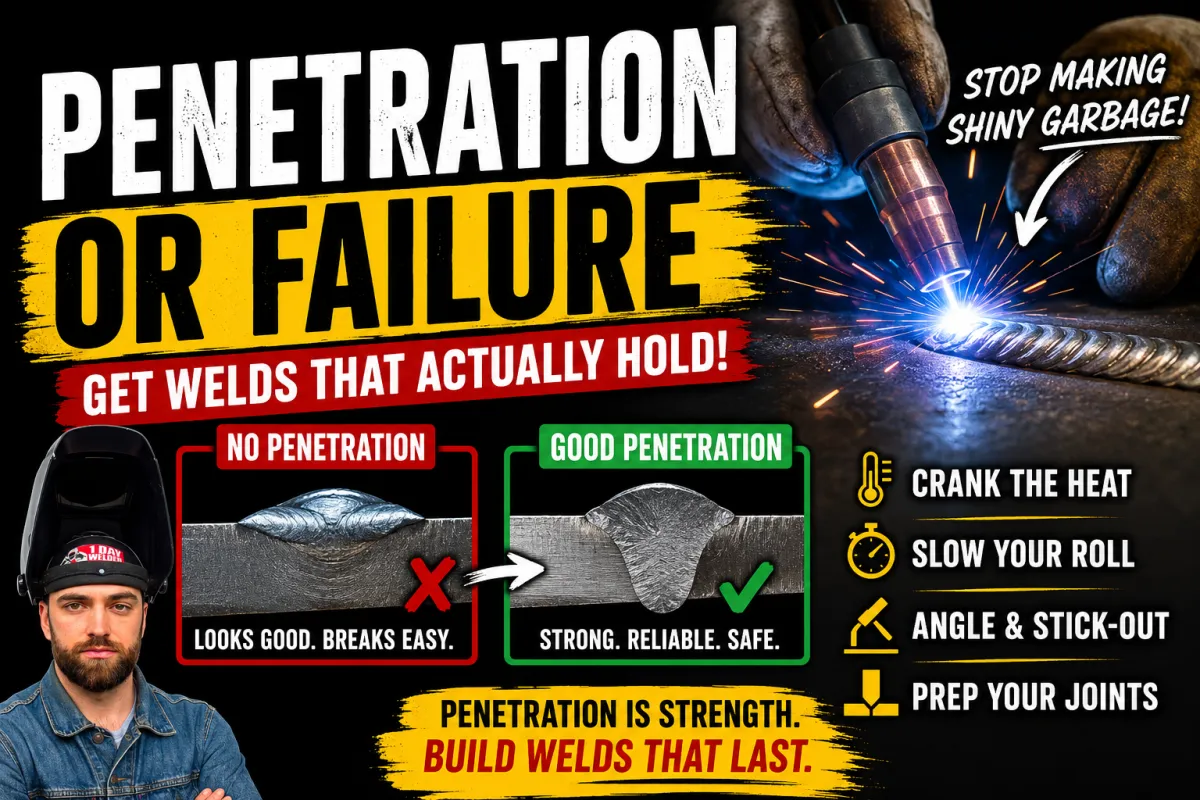
You can lay down the prettiest bead in the world, perfectly stacked dimes, but if it doesn't penetrate, it's just shiny garbage on top of your metal. That weld might look great on the surface, but if it breaks under stress, you've got a bad weld – and a potential safety hazard.
Why This Matters
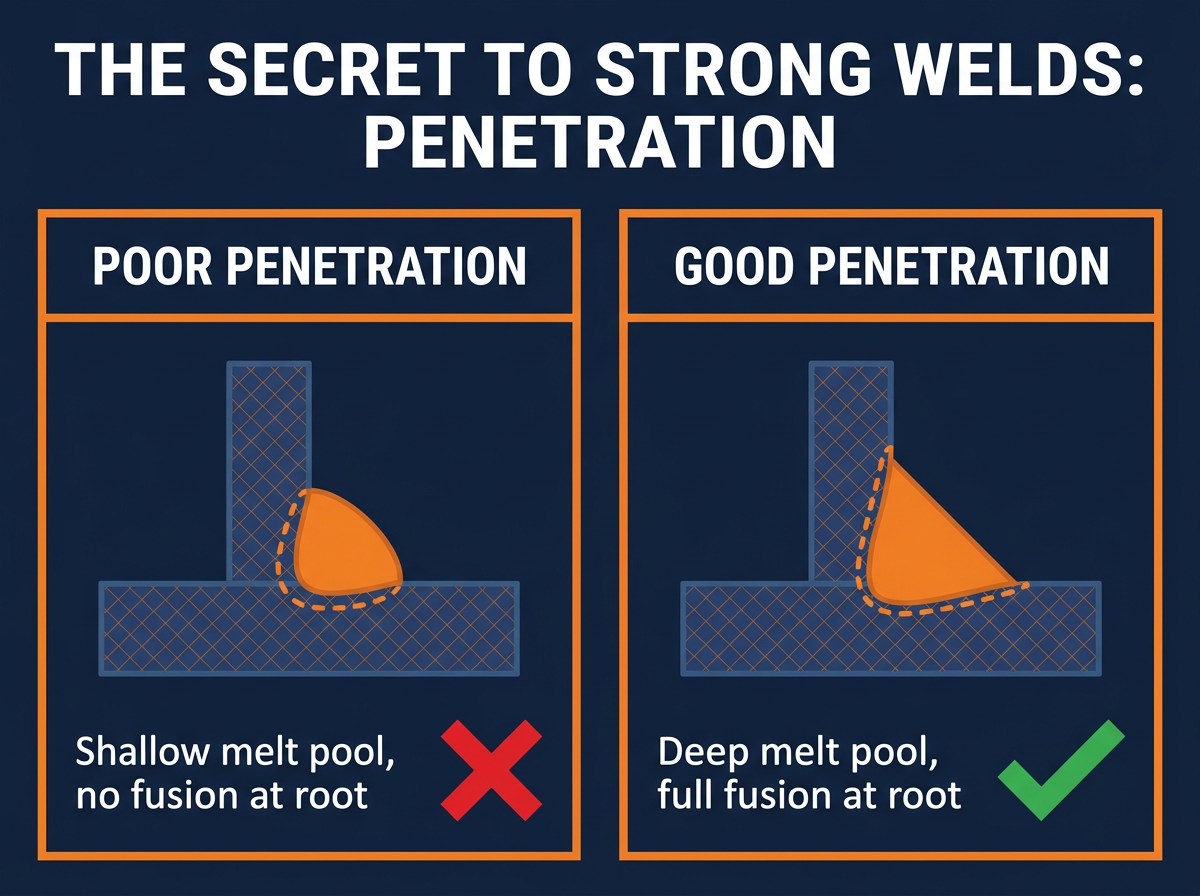
Penetration isn't just a fancy word; it's the core of a strong, lasting weld. It's how deep your molten metal fuses with the base material, locking everything together. Skip this, and you're building junk that's destined to fail.
Crank Up the Heat (But Not Too Much)
Too little heat is the biggest killer of good penetration. Your arc needs enough juice to dig into that base metal, not just skim the surface.
For MIG, that means enough voltage and wire speed. If you're welding 1/4" mild steel with a Miller Multimatic 215, try starting around 19V and 220 IPM. Listen to that bacon-sizzling sound – that's your arc digging in.
Stick welding? Don't be afraid to push the amps. A Lincoln Electric AC225 'Tombstone' running a 7018 rod on 3/8" plate needs 110-130 amps to get that puddle to dig deep. You'll feel the difference.
TIG welding, it's all about foot pedal control. On 1/8" aluminum, you might need 150-180 amps AC, but you're feathering that pedal, letting the puddle form and dig, then easing off slightly as you move.
Travel Speed: Slow Your Roll
Moving too fast is another classic beginner mistake. You're trying to outrun the puddle, and it just doesn't have time to melt into the base metal.
Slow down. Let the arc work its magic. Watch the molten puddle as it washes into the joint – you should see it sinking down, creating a consistent keyhole in TIG, or a molten pool that looks like it's 'wetting out' nicely in MIG or stick.
Think of it like painting a wall. You don't just zip across; you move at a steady pace, letting the paint coat evenly. Same deal here. Take your time, focus on that puddle action.
Stick-Out and Angle: Get In There
Your wire or electrode stick-out (the amount extending from the contact tip or holder) plays a big role. Too much stick-out in MIG means less current reaching the arc, cooling it down and reducing penetration.
Keep your MIG stick-out tight, maybe 3/8" to 1/2" for most projects. For stick welding, keep that arc tight to the plate, just enough to maintain a consistent puddle. Too long and you're fighting instability and losing heat.
Your work and travel angles are critical too. Angle the torch or electrode into the joint, pushing that molten puddle ahead of the arc. This helps drive heat into the root and ensures better fusion.
For a fillet weld, a 45-degree work angle is a good starting point, with a slight push or drag angle depending on your process and preference. Experiment, but always aim to direct that heat where you need the penetration.
Joint Prep: More Than Just Clean Metal
Yeah, clean metal is non-negotiable – we've covered that. But for real penetration, especially on thicker stuff, you need to think about joint design.
On anything over 1/4" thick, a simple square butt joint won't cut it for full penetration. You'll need to bevel the edges. Use an angle grinder with a grinding disc or a specialized beveling tool to create a V-groove or J-groove.
This bevel gives your arc a path to the root of the joint, allowing the filler metal to fuse deep into both pieces. Without it, you're just putting a cap on top of a gap, and it'll fail.
Make sure you have a root opening too – a small gap between the pieces at the bottom of the bevel. This lets the arc get in there and create that crucial root pass. A 1/16" to 1/8" gap is common, depending on the process and material.
Common Mistakes
Running too cold: Not enough amps or voltage. Your puddle looks sluggish, or the bead just sits on top.
Too fast travel speed: You're outrunning the arc. The bead is ropey or has minimal tie-in to the base metal.
Excessive stick-out: Especially in MIG. It starves your arc of power, leading to cold, weak welds.
No joint preparation on thick material: Trying to get full penetration on 1/2" plate with a square butt joint is a fool's errand. Bevel it!
Wrong welding angle: Not directing the arc into the root of the joint, causing the filler metal to bridge rather than fuse deeply.
Closing Encouragement
Getting good penetration takes practice, like everything else in welding. Don't just look at the top of your bead; flip that piece over. Look at the back – see if you got a consistent bead showing through (that's called 'suck back' or 'root reinforcement').
For critical welds, cut a sample, etch it, and look at the cross-section. That's the real truth. Keep practicing, adjust those settings, and you'll be building bulletproof welds in no time. Now go stack some dimes that actually hold!
Quinn "The Welder" Morrissette
Join 30,000+ students learning to weld at home with my online course:
>>> Check out 1 Day Welder here
>>> Shop the 1 Day Welder Amazon Store