Listen to Your Weld for Perfect Beads
Most beginners stare at the puddle, trying to make sense of the molten metal. But the real pros? They listen to their weld. Your arc isn't just making noise; it's screaming messages at you, telling you exactly what's going on, and whether your settings are dialed in or way off.
Ignoring these auditory cues is like driving blindfolded. Sound provides instant feedback, often faster and clearer than your eyes can process. Learning to 'hear' your weld lets you diagnose problems like insufficient gas, wrong heat, or bad technique before they turn into a pile of ugly, weak metal. It's the secret language of strong, consistent beads.
The Sizzle of a Perfect MIG Arc
A healthy MIG arc isn't just noise; it's a consistent, almost rhythmic sizzle, like bacon frying in a hot pan. That steady crackle tells you everything's aligned: your voltage and wire speed are perfectly balanced, your shielding gas is flowing strong, and the metal is melting into a beautiful, uniform puddle. This is the sound of deep penetration and a strong bond – pure fusion happening right where you want it.
Hear a harsh, sputtering pop, almost like firecrackers? That usually means your wire speed is too high for your voltage, jamming cold wire into the molten puddle and causing spatter. On the flip side, a soft, airy hiss or a dull buzz often signals too much voltage for your wire speed, or worse, poor gas coverage due to a breeze or a clogged nozzle. Adjust your settings or check your gas flow, and listen for that sweet sizzle to return.
TIG's Smooth Whisper
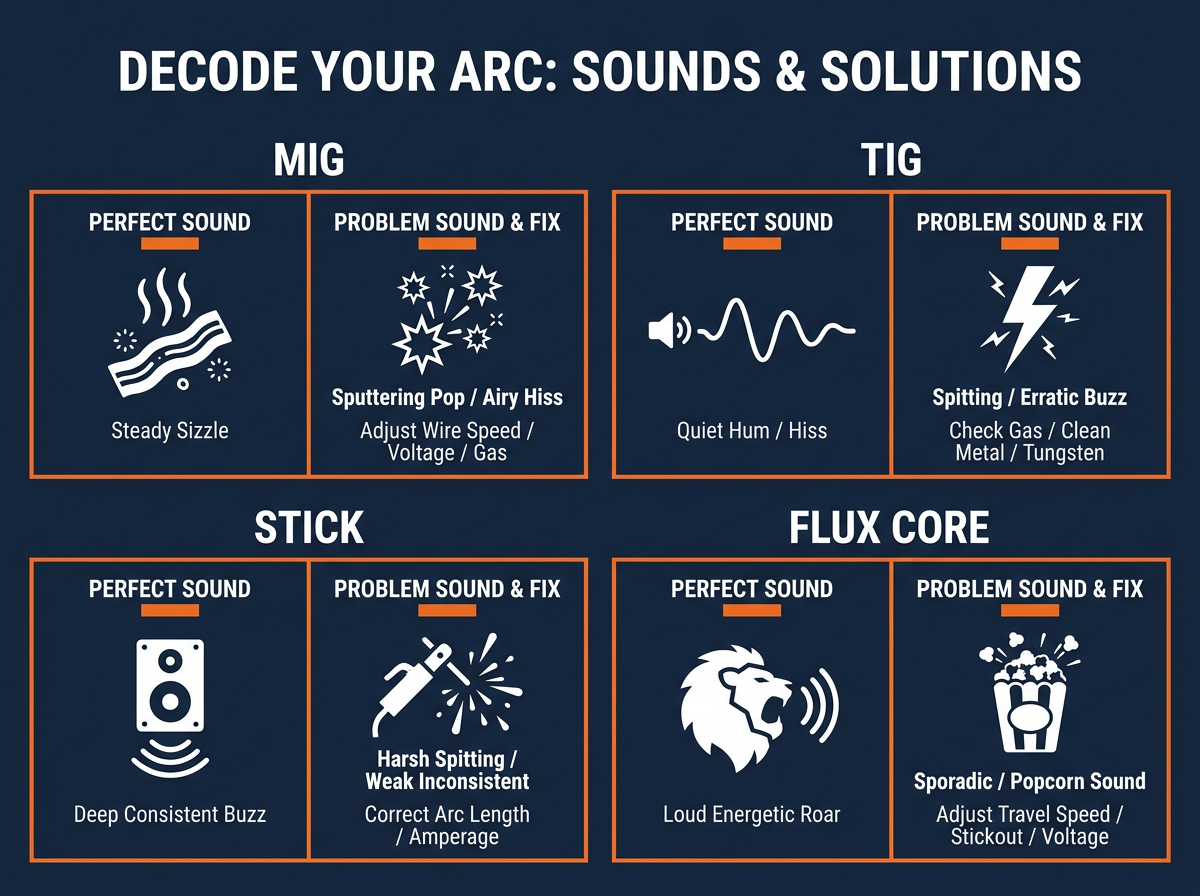
TIG welding demands precision, and its ideal sound reflects that control. A perfect TIG arc should be a quiet, consistent hum – almost a gentle, steady hiss, like air escaping a tire slowly. This subtle sound confirms a stable arc, perfectly clean tungsten, and uninterrupted argon shielding, all working together to protect the delicate molten puddle from atmospheric contamination. It’s the sound of ultra-clean, high-quality fusion.
If you hear spitting, crackling, or an erratic buzz, you've got problems. A loud pop can mean your tungsten just touched the puddle, contaminating it. An inconsistent hiss might point to insufficient argon flow from a leak or too much wind, or perhaps a dirty workpiece introducing impurities. Stop, clean your metal thoroughly, check your gas lines, and regrind that tungsten point to a sharp, clean tip.
Stick's Steady Rumble
Stick welding is raw power, and its ideal sound is a deep, consistent buzzing or humming, like a focused, low-frequency roar. It's a powerful, steady rumble that means your arc length is dialed in – not too long, not too short – your amperage is correct for the specific electrode you’re running (say, a Lincoln 7018), and the flux coating is burning off evenly, creating that essential protective slag. This is the sound of penetration.
A harsh, spitting, or excessively loud popping sound usually indicates your arc length is too long; you're stretching the arc and losing control. If it sounds weak, inconsistent, or the electrode keeps sticking, your amperage might be too low, or you're moving too fast. Maintain a short, tight arc that's just a hair longer than the electrode diameter, and you'll get that satisfying, powerful, consistent hum.
Flux Core's Energetic Roar
Flux core doesn't do quiet. Its ideal sound is a steady, energetic roar or a loud, consistent crackle, much more aggressive than MIG. This powerful, assertive sound tells you the self-shielding flux is burning off correctly, generating its own protective gas and slag, and digging deep for excellent penetration – perfect for dirty metal or outdoor jobs. Think of it as a controlled, continuous explosion.
If that roar becomes sporadic, too soft, or sounds like dry popcorn popping, you need to check your settings. You might be moving too fast, your stickout could be too long, or your voltage might be too low for the wire speed. Flux core likes to be heard and felt. When its voice changes, slow your travel speed, adjust your contact tip height (stickout), and make sure your Hobart Handler 140 is pushing enough juice.
Common Mistakes When Listening to Your Weld
- Ignoring the Sound Entirely: The biggest mistake! Many beginners focus only on the visual puddle, missing critical audio cues that could save their weld.
- Wearing Inadequate Hearing Protection: You need good hearing protection to prevent damage, but it also needs to let you hear the nuances of the arc. Don't cheap out.
- Assuming All Arcs Sound the Same: Each process – MIG, TIG, Stick, Flux Core – has its own unique 'voice.' Learn them individually.
- Not Correlating Sound with Technique: When the sound changes, immediately ask yourself: What did I just do? Did I move faster? Change my angle?
- Over-Relying on Visual Cues Alone: While the puddle is important, it's a lagging indicator. Sound is real-time feedback that helps you adjust before the puddle looks bad.
Learning to interpret the language of your arc takes practice, but it's a skill that will elevate your welding dramatically. Soon, you won't just see a good weld; you'll hear one forming. Trust your ears as much as your eyes, and you'll be laying down perfect beads with confidence.
Quinn "The Arc Whisperer" Morrissette
Join 30,000+ students learning to weld at home with my online course:
>>> Check out 1 Day Welder here
>>> Shop the 1 Day Welder Amazon Store