How to Pick the Right Shielding Gas for MIG & TIG Welding
Most beginners just grab whatever gas canister is cheapest. That's like trying to weld titanium with a coat hanger.
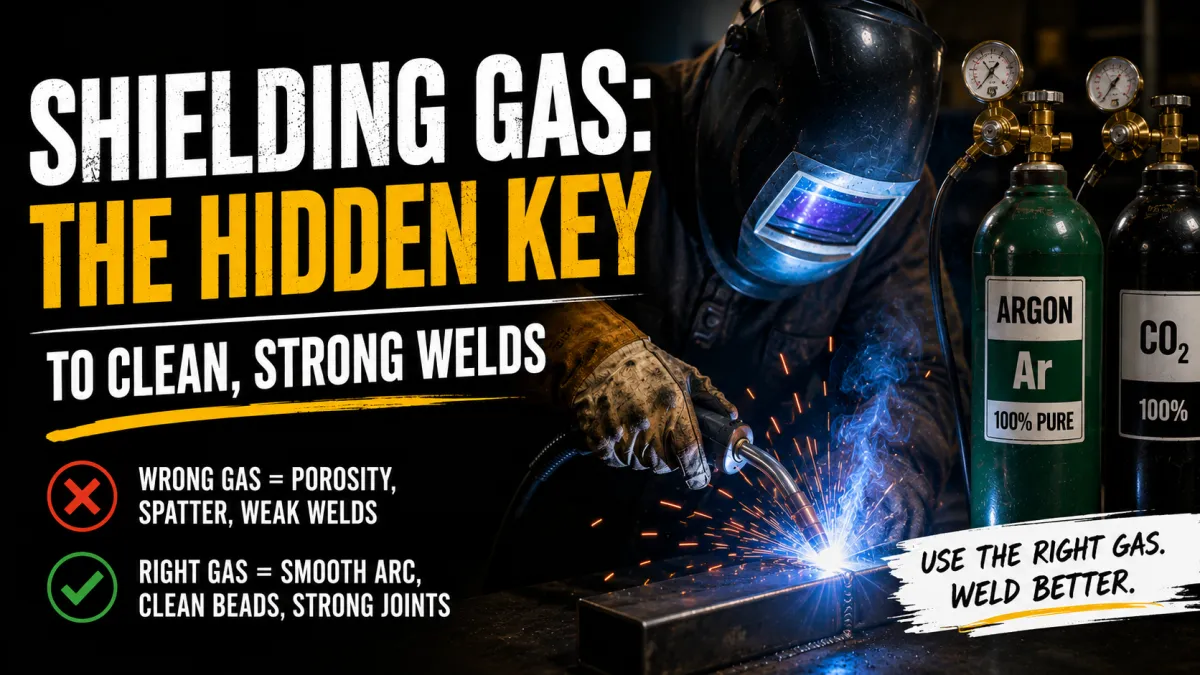
The right shielding gas isn't just a detail; it's the invisible force field around your weld puddle. Screw it up, and you're fighting porosity, spatter, and weak welds from the start. Get it right, and your arc sings, your beads lay down smooth, and your joints hold strong.
MIG Gas 101: The CO2 vs. Argon Mix
For mild steel MIG welding, you've got a couple of main players. Pure CO2 is cheap and gives you deep penetration, which is great for thicker stuff or if you're battling some surface rust. But be warned: it's a harsher arc, and you'll get more spatter to clean up.
The real workhorse for home welders is 75% Argon / 25% CO2, often called C25 or Ar/CO2. This mix hits the sweet spot. You get excellent arc stability, good penetration, and significantly less spatter than pure CO2. Your beads will look cleaner and lay down smoother with C25.
If you're welding stainless steel with MIG in short circuit transfer, you'll often step up to higher argon mixes like 90% Argon / 10% CO2. This reduces spatter even further and gives you better wetting for that smooth stainless finish. But stick to C25 for your everyday mild steel projects.
TIG Gas: Pure Argon, No Compromises (Mostly)
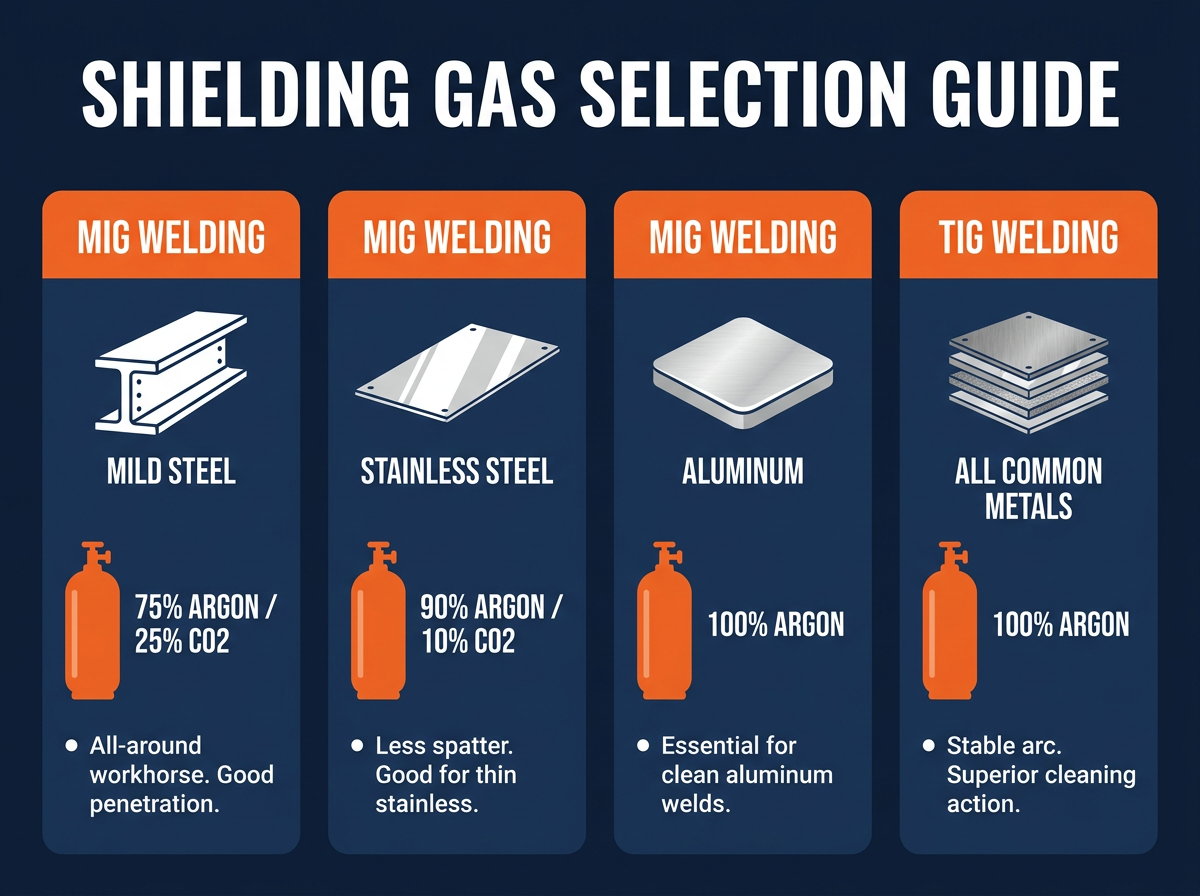
When it comes to TIG welding, there's one king: 100% Pure Argon. It's an inert gas, meaning it won't react with your molten metal, which is exactly what you want for a super clean, stable arc. Pure argon is essential for TIG welding mild steel, stainless steel, and especially aluminum.
Yeah, you can find Argon/Helium mixes out there. These hotter mixes are for heavy-duty applications on thick aluminum or magnesium, allowing for faster travel speeds. But for beginners, or frankly, for 99% of home shop TIG work, pure argon is what you need. Don't overthink it, just grab the pure stuff.
Specialty Gases: Stainless Steel & Aluminum MIG
MIG welding stainless steel needs specific gas to prevent chromium oxidation and maintain corrosion resistance. For short circuit transfer, a 90% Argon / 10% CO2 mix works well, or sometimes even fancy tri-mixes (Argon/Helium/CO2) are used for spray transfer. Always check your wire manufacturer's recommendation.
For MIG welding aluminum, you absolutely need 100% Pure Argon. No CO2, no mixes with CO2. CO2 reacts with aluminum and will give you ugly, porous, and weak welds. Just like with TIG aluminum, pure argon provides the inert shield needed for strong, clean aluminum MIG welds. If you're using a spool gun, you're almost certainly using pure argon.
Flow Rate: Don't Just Crank It
Having the right gas isn't enough; you also need the right flow rate. Too little gas flow, and ambient air sneaks into your weld puddle, causing porosity and contamination. Your welds will look like Swiss cheese and be weak as hell.
Cranking the gas up too high isn't the answer either. You're just wasting expensive gas. Plus, too much flow can create turbulence that actually pulls in more air, ironically leading to the same contamination issues. Excessive flow can also cool your weld puddle, making it harder to manage.
A good starting point for most MIG welding is 15-25 cubic feet per hour (CFH). For TIG welding, aim for 15-20 CFH. Always check your gas regulator's gauge and make sure your connections are tight. A tiny leak can cost you a cylinder of gas and a bunch of bad welds.
Common Mistakes
Using the wrong gas for the metal or process: Trying to TIG weld with C25 or MIG aluminum with CO2 is a recipe for disaster.
Incorrect flow rate: Too low leads to porosity; too high wastes gas and can still cause contamination.
Leaky gas lines or connections: The silent killer of good welds. Always check your fittings and hoses.
Running out of gas mid-weld: Always check your cylinder pressure before you start a big project. Nothing's worse than running dry when you're in the zone.
Picking the right shielding gas isn't rocket science, but it's crucial. Get this dialed in, and you'll see a massive difference in your weld quality and confidence. No more fighting the arc – just smooth, strong welds every time.
Quinn "The Weld Whisperer" Morrissette
Join 30,000+ students learning to weld at home with my online course:
>>> Check out 1 Day Welder here
>>> Shop the 1 Day Welder Amazon Store