How to Pick the Right Stick Electrode
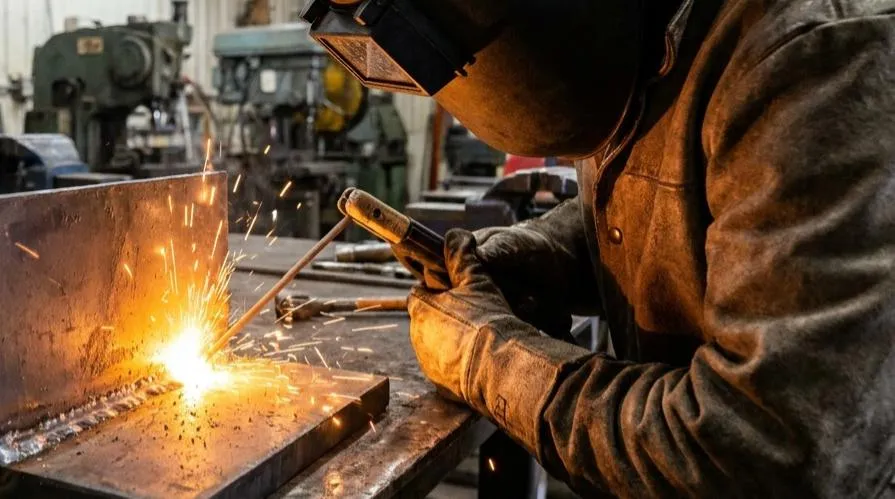
Picking the right electrode isn't rocket science, but it’s crucial. The right rod makes welding easier, gives you stronger joints, and leaves you with a bead you can actually be proud of. Get it wrong, and you're fighting an uphill battle against porosity, slag inclusions, and weak welds that'll fail when you need 'em most.
Decoding the Numbers on Your Rod
Every stick electrode has a code like E6010 or E7018. Break it down:
- E: Stands for "electrode." Easy enough.
- First Two (or Three) Digits: This is the minimum tensile strength of the deposited weld metal, in thousands of pounds per square inch (PSI). So, E60xx means 60,000 PSI, E70xx means 70,000 PSI. Strong stuff.
- Third Digit: This tells you the welding position. "1" means all positions (flat, horizontal, vertical, overhead). "2" means flat and horizontal only. "4" means flat, horizontal, vertical-down, and overhead.
- Fourth Digit: This is where things get interesting. It indicates the type of coating, penetration, and the kind of current (AC/DC) you should be using. This is the secret sauce.
Understanding this code is your first step to becoming a rod whisperer. Don't just grab a random stick; read its damn label.
The "Dirty Dozen": E6010 and E6011
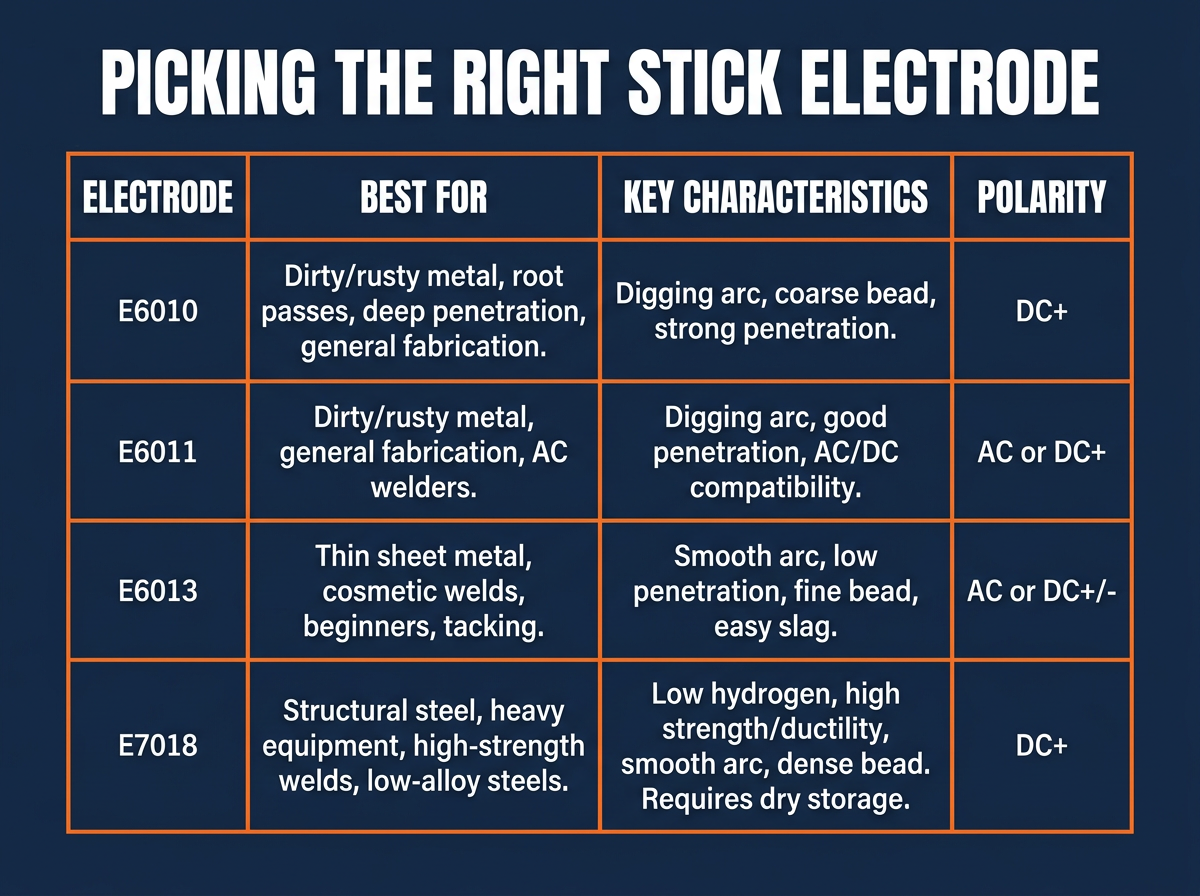
These are your workhorses for general fabrication, especially when the metal isn't perfectly clean. Think rusty farm equipment, painted steel, or greasy repairs. They burn hot and deep, cutting through crap like a plasma torch through butter.
E6010: The Penetrator (DC Only)
This rod runs on DC+ (Reverse Polarity) only. It's got a strong, digging arc that's perfect for deep penetration, making it great for root passes and welding through rust, paint, and mill scale. You'll get a coarse, rippled bead, but man, is it strong. Lincoln Electric's Fleetweld 5P+ is a classic example.
E6011: The AC Alternative
If you've got an AC-only stick welder, the E6011 is your best friend. It shares many characteristics with the 6010 – deep penetration and good for dirty metal – but it's designed to run on AC or DC. It's not quite as smooth or as deep-penetrating as a 6010, but it gets the job done when you're stuck with AC. Hobart's 6011 is a solid choice.
The "Easy Rider": E6013
If you're looking for a smooth, easy-to-run rod that produces a pretty bead, the E6013 is it. It runs on both AC and DC (either polarity). This rod is a go-to for beginners and for welding thinner materials where excessive penetration could blow through.
It gives you a smooth, fine-grained bead with minimal spatter and easy slag removal. It's not for structural joints or dirty metal, but for cosmetic welds, tacking, or light sheet metal work, it’s a dream. Think decorative gates or thin tubing. Miller's Blue Demon E6013 is a common sight.
The "Strongman": E7018
When you need serious strength and ductility, reach for the E7018. This is a low-hydrogen electrode designed for high-strength, crack-resistant welds on mild and low-alloy steels. It's the choice for structural steel, heavy equipment, and anything that needs to hold up under stress.
E7018 runs best on DC+ (Reverse Polarity) and produces a super smooth, dense bead with excellent mechanical properties. The catch? It needs clean metal and needs to be kept dry – often stored in a rod oven – to prevent hydrogen pickup, which causes cracking. Think bridge construction or heavy machinery repair. Lincoln's Excalibur 7018 is legendary.
Common Mistakes When Picking a Rod
- Using the wrong rod for dirty metal: Trying to run E7018 on rusty, painted steel is like trying to comb a dog with a rake. It just won't work well. You'll get porosity, undercut, and a miserable weld. Stick to 6010 or 6011 for anything less than pristine.
- Ignoring electrode storage: Especially with E7018, moisture is the enemy. If your 7018 rods have been sitting out in a damp garage, they're probably compromised. They need to be kept dry, often in a heated rod oven, to maintain their low-hydrogen properties.
- Using the wrong polarity: Some rods are DC+ only (like 6010), some prefer DC- (rare for common rods but exists), and others are fine with AC. Check the rod's specs. Running 6010 on AC is a recipe for a crappy, unstable arc.
- Over-penetrating thin material: Slamming a 6010 rod into 1/16" sheet metal is a sure way to blow a hole big enough to stick your finger through. For thinner stuff, especially for beginners, 6013 is often a safer bet.
Your welder isn't always the problem; sometimes, it's just a misunderstanding with your rod. Learn their personalities, and you'll unlock a whole new level of welding confidence. Experiment with different electrodes on scrap metal. Feel how they burn, see how the puddle reacts. You'll quickly develop a feel for which rod is right for the job.
Keep sparking,
Quinn "The Rod Whisperer" Morrissette
Join 30,000+ students learning to weld at home with my online course:
>>> Check out 1 Day Welder here
>>> Shop the 1 Day Welder Amazon Store