How to Pick the Right Tungsten for TIG Welding (Without Losing Your Mind)
TIG tungsten selection is where most beginners freeze up.
You walk into the welding supply store. You see a wall of color-coded electrodes. Red, blue, orange, green, gold. Nobody tells you what matters. You grab a pack and hope it works.
Here's the truth. For 90% of what you'll weld as a beginner, one tungsten does the job. You don't need a drawer full.
Why the Colors Matter
Each tungsten has a different oxide mixed into it. That oxide changes how the electrode handles heat, how easy the arc starts, and what metals it likes. The colored tip is a code. Nothing more.
You need one that starts an arc cleanly, holds a sharp point, and doesn't contaminate your weld. That's it.
The One Tungsten You Actually Need: 2% Lanthanated (Blue)
If you buy one tungsten, buy this. 2% lanthanated is the closest thing to a do-it-all electrode.
It welds steel. It welds aluminum. It runs on AC and DC. It's non-radioactive, unlike thoriated. And it holds a sharp point better than ceriated or pure tungsten.
Most TIG welders I know have moved to blue over the last decade. It just works.
The Other Colors, Quick Version
Here's when the other tungstens make sense. Not before.
Red (2% Thoriated): Old-school favorite for DC work on steel. Arcs start great. Downside — it's slightly radioactive when you grind it. Wear a mask and use dedicated ventilation. If you already own a pack, fine. Don't go buy more.
Orange (2% Ceriated): Best for low amperage work under 80 amps. Great for thin sheet metal, jewelry, and repair on small parts.
Green (Pure Tungsten): AC only. Forms a balled tip for aluminum. Blue does the job better now. Skip it.
Gold (1.5% Lanthanated): Same idea as blue, slightly different oxide percentage. Works fine. Don't overthink it.
Size Matters More Than Color
Most beginners mess this up. They grab a 3/32" tungsten and try to run it at 40 amps on thin sheet. The arc wanders. The tip balls up. The weld looks like a bad hangover.
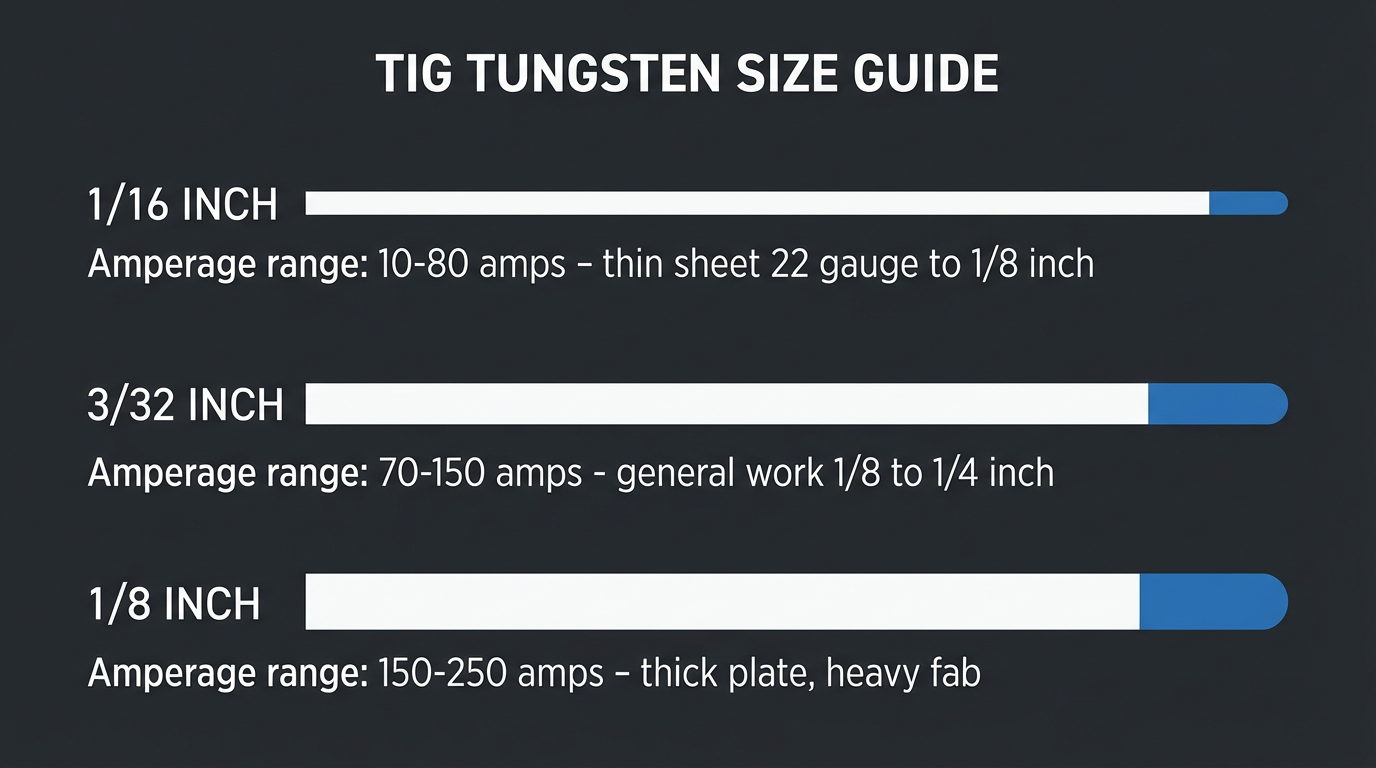
Match the diameter to your amperage. Rough guide:
1/16" tungsten: 10–80 amps (thin stuff, 22 gauge to 1/8")
3/32" tungsten: 70–150 amps (most general work, 1/8" to 1/4")
1/8" tungsten: 150–250 amps (thick plate, heavy fab)
For a home shop running a 200-amp machine, 3/32" is the workhorse. Keep a sleeve of 1/16" around for thin stuff.
Grind It Right
A dull tungsten gives you a wide, wandering arc. A properly ground tungsten gives you laser control.
Grind the point lengthwise, not across. The scratches should run with the tungsten, like a sharpened pencil. Across-the-grain scratches scatter the arc and mess up your bead.
Point length should be about 2 to 2.5 times the tungsten diameter. So for a 3/32" tungsten, grind a taper roughly 3/16" to 1/4" long. Not a needle. Not a blunt nub. Just a clean taper.
Use a dedicated tungsten grinder or a bench grinder with a fine wheel you only use for tungsten. Contamination from grinding steel or aluminum on the same wheel ruins your electrode.
Start Simple. Upgrade Later.
Buy a 10-pack of 3/32" blue lanthanated. Buy a 5-pack of 1/16" blue lanthanated. That's $20–30 total and covers almost everything you'll weld for the next year.
Once you're running 500+ hours and know what you're doing, experiment. Until then, blue is your friend.
Join 30,000+ students learning to weld at home with my online course:
>>> Check out 1 Day Welder here
>>> Shop the 1 Day Welder Amazon Store
Talk soon,
Quinn "blue tungsten does it all" Morrissette
P.S. Keep your tungsten in the original plastic tube until you grind it. Dropping a fresh electrode on a dusty shop floor is a great way to contaminate the tip before you've even struck an arc. Ask me how I know.