How to Read Welding Symbols (Without Getting Lost on a Blueprint)
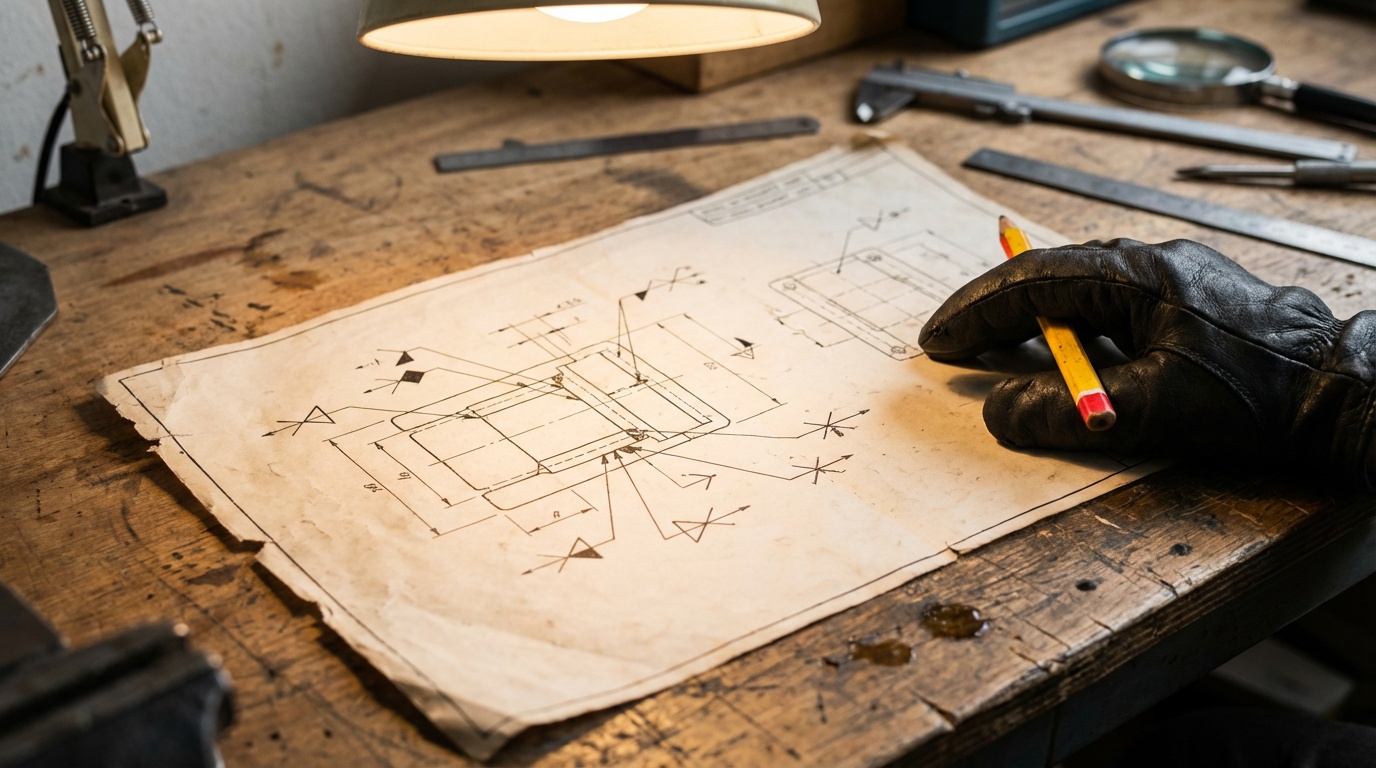
The first time a customer handed me a blueprint with welding symbols on it, I stared at it like it was written in Sumerian.
Lines, arrows, little numbers, weird letters, some kind of flag thing on the side. I had no idea what any of it meant.
Five years later I was the one drawing them. Turns out it's not complicated — it's just a code. And once you crack the code, you can read 90% of any blueprint in about ten seconds.
Here's the cheat-sheet version.
Why bother learning this?
If you only weld your own projects, you can probably skip this article.
But the second you start doing fab work, custom builds for clients, or anything that comes with a plan — you'll see welding symbols. They tell you what kind of weld, where it goes, how big it is, and how long. Misread one and you can turn an $800 bracket into $800 of scrap.
Plus, once you can read them, you can write them. Being able to send a sketch with proper symbols to a fab shop or another welder is the difference between "looks pro" and "looks like a guy who taught himself in his garage."
The Anatomy: 3 parts to every symbol
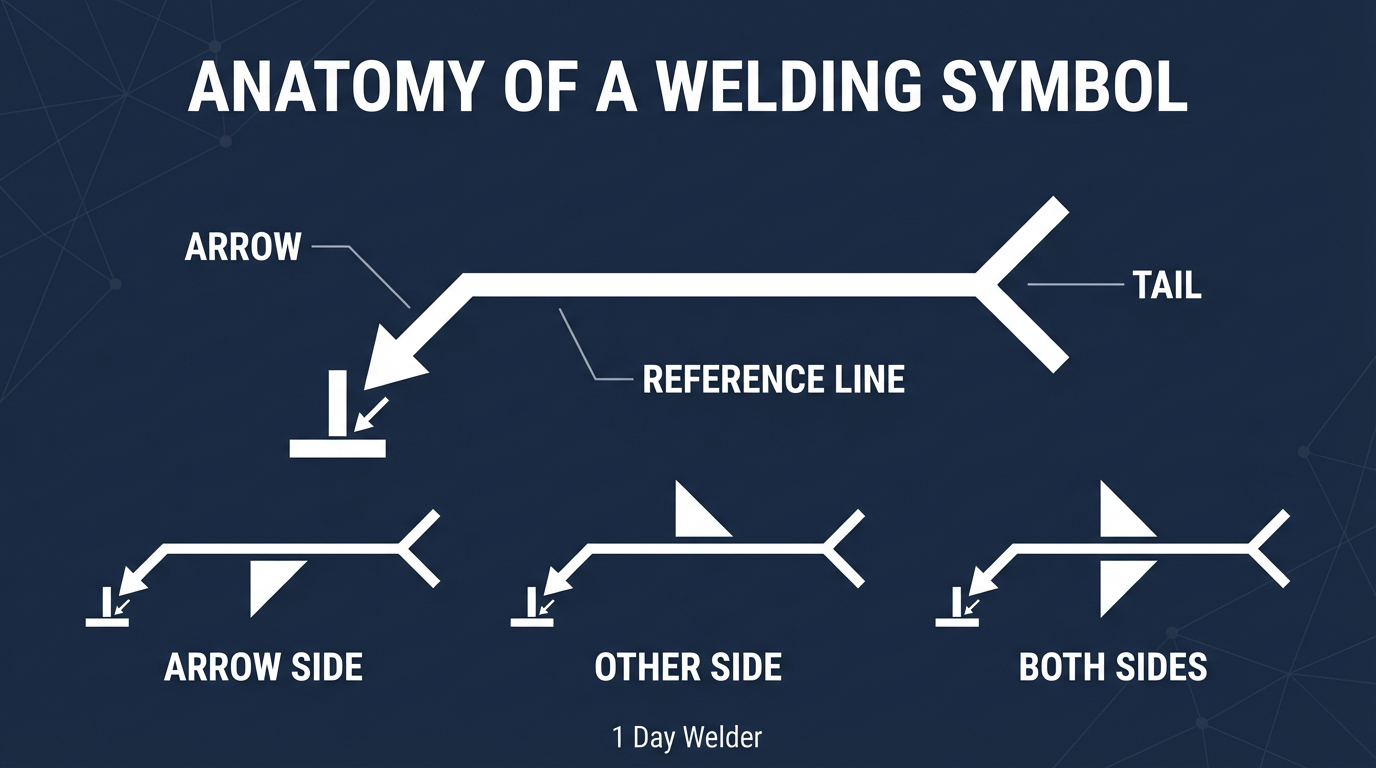
Every welding symbol has the same skeleton:
The arrow — points to the joint that needs to be welded.
The reference line — the horizontal line connected to the arrow. All the actual symbol info lives on this line.
The tail — the little forked thing on the end. Optional. It holds extra notes like process, filler rod, or a spec callout.
That's it. Arrow → reference line → optional tail.
Now the magic: where you put the weld symbol on the reference line tells the welder which side of the joint to weld.
Arrow Side vs. Other Side (the rule that trips everyone up)
Look at the reference line. The arrow comes off it pointing at the joint.
Symbol BELOW the line = weld on the arrow side of the joint (the side the arrow is pointing at).
Symbol ABOVE the line = weld on the other side (the back side, away from the arrow).
Symbol on BOTH sides = weld both sides.
This is the rule everyone gets wrong the first time. Arrow side = below the line. Say it ten times. Tape it inside your hood if you have to.
The 5 symbols you'll actually see most
There are about 20 of them in the AWS A2.4 standard. You don't need 20. You need these.
Fillet weld (small triangle) — the most common weld in fab work. T-joints, lap joints, anything that looks like an L or a T.
Groove weld (V, U, or square shape) — for butt joints where the edges are beveled. The shape tells you the bevel: V-groove, U-groove, square-groove.
Plug weld (small rectangle) — a weld that fills a hole, usually used to attach overlapping plates.
Spot weld (small circle) — a single localized weld, common in sheet metal and automotive.
Bevel weld (J or square-with-slash) — like a groove, but only ONE piece is beveled.
Memorize the triangle and the V. Those two cover maybe 80% of what you'll see in real shop work.
The numbers around the symbol = sizes and lengths
Numbers tell you dimensions. Read them in this order:
Number to the LEFT of the symbol = leg length (or throat thickness for fillets), in inches.
Number to the RIGHT = length of the weld.
Two numbers separated by a dash (like 3-6) = length of weld, then pitch (center-to-center spacing) for intermittent welds.
So a fillet symbol with `1/4` to the left and `4-12` to the right means: a 1/4-inch fillet weld, 4 inches long, repeated every 12 inches center-to-center. Stitch welding.
The two flags you'll see all the time
Open circle at the bend between arrow and reference line = "weld ALL AROUND." The same symbol applies continuously around the perimeter of the joint.
Filled black flag at the bend = "FIELD WELD." Means weld it on-site, not in the shop.
The side rule + the 5 shapes + those two flags will get you through 90% of any blueprint you'll see.
Common Mistakes
Welding the wrong side. If the symbol is below the reference line and you weld the top of the joint, you just made a thousand-dollar mistake. Read the side rule three times.
Skipping the tail. The tail tells you what process and what filler. If it says E7018 and you grab a MIG gun, you're not following the print — you're guessing.
Misreading intermittent weld notation. A "3-6" is NOT a continuous 6-inch weld. It's a 3-inch weld every 6 inches. Get this wrong and you weld too much OR too little — both fail inspection.
Assuming "weld all around" means a fillet. The all-around flag just means whatever symbol is on the line applies the whole way around. The shape still tells you what kind of weld.
Not asking when you're stuck. Engineers expect questions on prints. Ask. It's cheaper than redoing the part.
You can read any blueprint with practice. If you're just starting out or need a refresher in welding, join 30,000+ students learning to weld at home with my online course:
>>> Check out 1 Day Welder here
>>> Shop the 1 Day Welder Amazon Store
Talk soon,
Quinn "looked like Sumerian to me too" Morrissette