The #1 Welding Mistake: Polarity
You've checked your voltage, your wire speed, even the gas flow, but nothing fixes it. The silent killer? Wrong polarity.
Polarity isn't just a setting; it's how you tell the electricity where to send the heat. Get it wrong, and you're fighting an uphill battle against poor penetration, excessive spatter, and a miserable welding experience. Get it right, and your welds will look cleaner, penetrate better, and the arc will hum like a well-tuned engine.
Direct Current Electrode Negative (DCEN): The Deep Diver
Think of DCEN (Direct Current Electrode Negative), also known as straight polarity, as pushing the heat deep into your workpiece. With DCEN, the electrons flow from the electrode into the metal, concentrating about 70% of the heat in the workpiece itself and only 30% on the electrode. This gives you excellent penetration.
You'll typically use DCEN for TIG welding on steel or stainless steel, where you want a focused arc and deep, narrow penetration. Some stick electrodes, like the Lincoln Electric 6011 or 6013, can also run on DCEN for deeper bite, especially on dirty or rusty material. Your tungsten in TIG welding will thank you too, as it stays cooler and lasts longer.
Direct Current Electrode Positive (DCEP): The Surface Cleaner
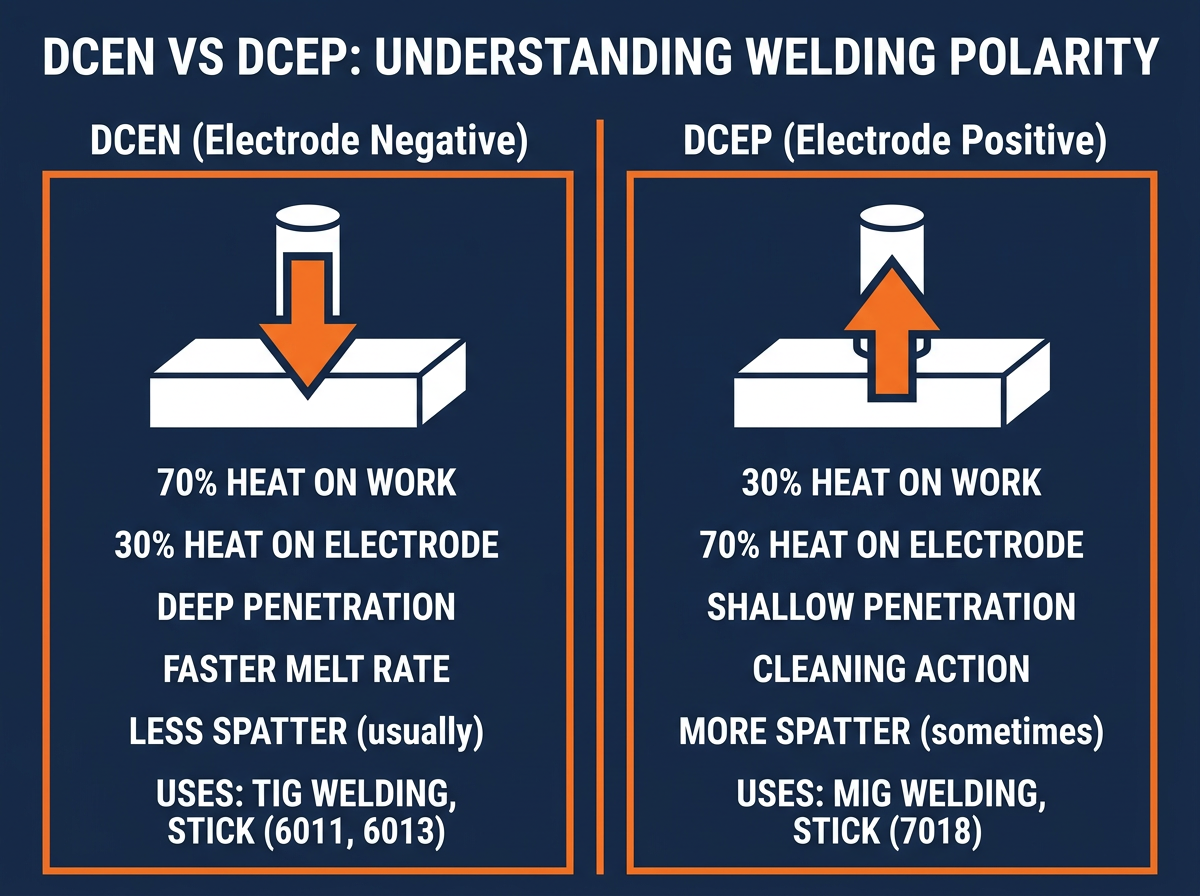
Now flip the switch to DCEP (Direct Current Electrode Positive), or reverse polarity. Here, the electrons flow from the workpiece to the electrode. This concentrates about 70% of the heat on the electrode and only 30% on the workpiece. You get shallower penetration but a powerful "cleaning action" that blasts away oxides.
DCEP is your go-to for MIG welding with solid wire. It ensures good fusion, a stable arc, and that crucial cleaning action that helps melt away surface contaminants. Most stick welding, especially with common rods like the Miller Electric 7018, also uses DCEP to provide a smooth, stable arc and good bead appearance.
Alternating Current (AC): The Balanced Act
AC (Alternating Current) is like having the best of both worlds, switching rapidly between DCEN and DCEP. This rapid switching helps to break up aluminum oxide, which is why AC is the champion for TIG welding aluminum. You get both good penetration and excellent cleaning.
For stick welding, AC can be used with specific rods like the 6011 or 6013, especially on older, transformer-based machines or when you need to avoid arc blow. While not as common for every process, understanding AC's role is key, especially if you're tackling aluminum with your TIG machine. Modern TIG machines like the Hobart EZ-TIG 165i give you easy control over the AC balance for fine-tuning that cleaning action.
How to Check and Change Your Polarity
Checking your polarity is simpler than you think. On most stick welders, it's about which terminal your electrode holder (stinger) and your ground clamp are connected to. If your stinger is on the positive (+) terminal and the ground is on the negative (-), you're running DCEP. Reverse those connections for DCEN.
For MIG welders, it's often an internal connection, usually behind a small door or panel on the front of the machine. You'll typically find a lead from the torch and a lead from the ground clamp that need to be swapped between positive and negative terminals. Always check your machine's manual – whether it's a Lincoln Electric PowerMIG or a Miller Millermatic – before you start swapping cables. Some newer machines might even have a digital setting, but don't count on it for every model.
Common Polarity Mistakes
MIG Welding on DCEN: You'll get tons of spatter, poor penetration, and the wire will just stub into the plate without melting properly. It's a mess.
TIG Welding DC on DCEP: Say goodbye to your tungsten. It'll overheat, ball up excessively, and melt back rapidly because all the heat is concentrated on it instead of the workpiece.
Ignoring Polarity for Stick Rods: Not all rods are created equal. Using a 7018 on DCEN will give you a weak, unstable arc and terrible penetration. Always match the rod's recommendation (found on the box) to your machine's setting.
Forgetting to Re-check: If you swap processes (say, from MIG to Stick), always double-check your connections. It's easy to forget and wonder why your next weld looks like garbage.
Don't let polarity be the mystery that ruins your welds. Take a minute to understand it, check your setup, and you'll immediately see a difference. Dial in that polarity, and you'll be laying down better beads with less frustration, guaranteed.
Quinn "The Polarity Pro" Morrissette
Join 30,000+ students learning to weld at home with my online course:
>>> Check out 1 Day Welder here
>>> Shop the 1 Day Welder Amazon Store