
MIG vs Flux-Core: When to Skip the Gas (And When You Really Shouldn't)
Most beginners walk into Harbor Freight, see a welder labeled "flux-core only," and think they got a deal. Sometimes they did. Sometimes they just bought a frustration with a power cord.
The MIG vs flux-core question isn't really about which is "better." It's about what you're welding, where you're welding it, and how clean you need it to look. Here's the honest breakdown — no theory, just what actually matters in the shop.
What's Actually Different
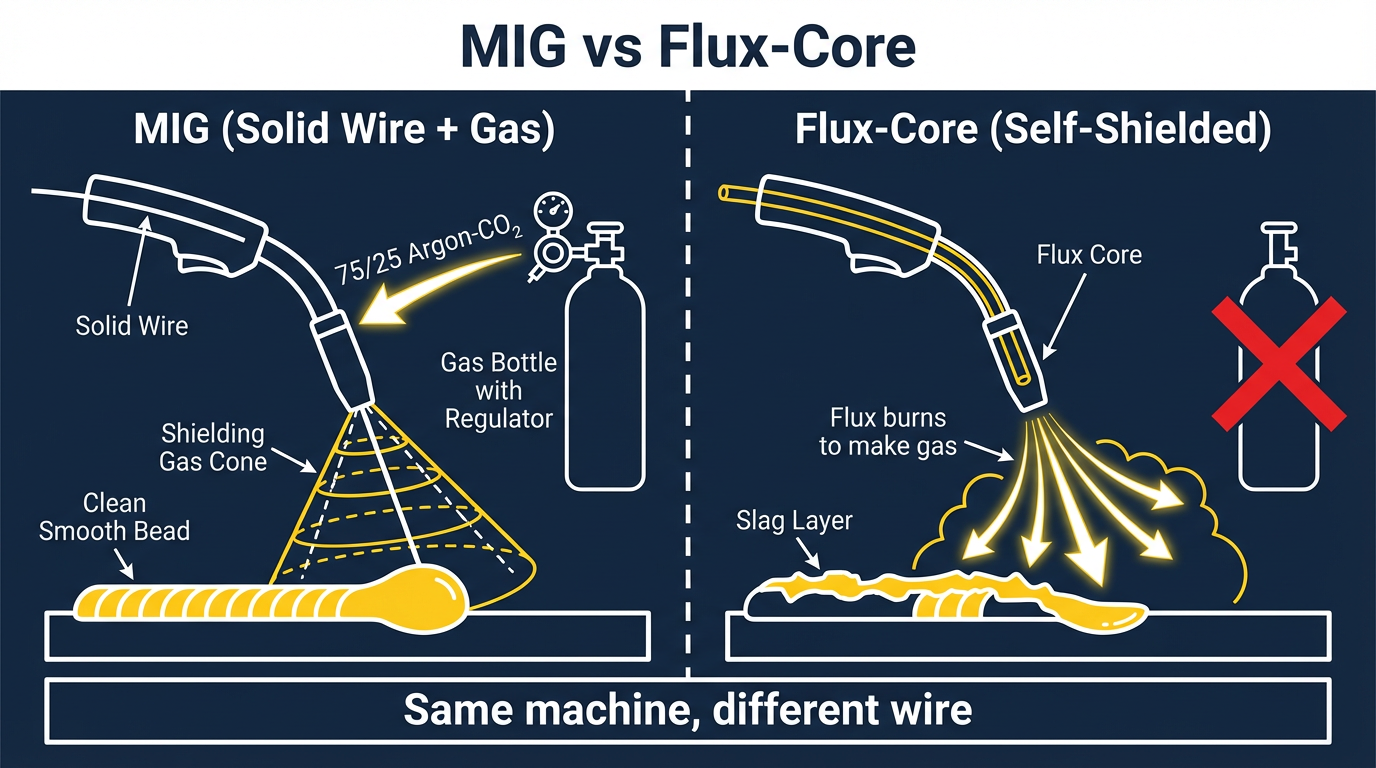
A MIG welder feeds a solid wire and shields the puddle with gas — usually a 75/25 argon-CO2 mix for steel. The gas pushes air away from the molten puddle so your weld stays clean.
Flux-core uses a hollow wire stuffed with flux. When the wire melts, the flux burns and creates its own shielding gas right at the arc. No bottle. No regulator. No hose.
Same machine. Different wire. Different rules.
When to Skip the Gas (Flux-Core Wins)
You're welding outside. Even a light breeze will blow shielding gas off your puddle and you'll get porosity that looks like Swiss cheese. Flux-core makes its own atmosphere right at the arc, so wind doesn't bother it nearly as much. If you're welding a fence in the yard or fixing a trailer in the driveway, flux-core is the move.
You're welding thicker steel and want deeper penetration. Flux-core wire (especially self-shielded E71T-11) bites deeper into the base metal than solid MIG wire at the same settings. For 1/4" and thicker structural stuff, flux-core is honestly the easier path.
You're welding rusty, painted, or dirty metal. I'm not telling you to skip prep — you should still wire-wheel it. But flux-core is way more forgiving on contamination than solid wire with gas. Solid MIG hates rust. Flux-core puts up with it.
You don't want to deal with a gas bottle. Bottles cost money, take up space, and run out at the worst possible time. If you weld occasionally and don't want a $300 bottle setup, flux-core is the simpler life.
When You Really Shouldn't Skip the Gas (MIG Wins)
You're welding thin sheet metal. Anything under 1/8" — auto body panels, exhaust pipe, small brackets — flux-core will burn right through it. Solid wire with gas runs cooler at low settings and gives you control. This is non-negotiable for autobody work.
You care what the weld looks like. Flux-core leaves slag on top of every bead. You have to chip and brush it off before you can see your actual weld. Then you've got that brownish discoloration around the bead. Solid wire MIG with gas leaves a clean, shiny bead with almost no spatter when it's dialed in. Big difference if you're building furniture or anything visible.
You're welding stainless or aluminum. Flux-core for stainless exists but it's specialty stuff. Aluminum flux-core wire isn't really a thing for hobby machines. If you're welding either of these, you need gas.
You're working indoors with no ventilation problems. Inside a clean shop with no wind, MIG with gas is faster, cleaner, and easier to learn on. The arc is more visible. The puddle is more predictable.
The Settings Trap Everybody Falls Into
Here's the thing nobody tells you: flux-core needs reverse polarity on most hobby machines. That means the ground clamp goes to positive on the welder, and the gun lead goes to negative. Solid MIG wire is the opposite — gun positive, ground negative.
If you switch wire types and forget to flip the polarity, your bead will look like a bird crapped on the metal. Spatter everywhere. No penetration. You'll think your machine is broken. It's not. You just have electrons going the wrong way.
Open the side panel of your welder before you start. There's almost always a diagram inside that shows the polarity for each wire type. Follow it.
Common Mistakes Beginners Make
Buying flux-core wire to "save money on gas," then using it indoors on thin metal. You'll fight the machine the whole time and hate welding. Use the right wire for the job.
Forgetting to chip the slag off between passes. If you weld over slag, you trap it inside the next bead. That's a guaranteed weak weld. Brush every pass.
Running flux-core too hot on thin material. Flux-core wants to penetrate deep. On 1/8" or thinner, drop your voltage and speed up your travel.
Mixing up shielding gases. 75/25 argon-CO2 is for solid MIG wire on steel. 100% CO2 also works but spatters more. 100% argon is for aluminum only — never use it on steel solid wire or your weld will look like garbage.
Storing flux-core wire wrong. Flux is hygroscopic. It absorbs moisture from the air, and wet flux means porosity. Keep your spool sealed in a bag with desiccant when you're not using it.
So Which One Should You Buy?
If you're doing any kind of work outside — fences, trailers, gates, ranch repair — get a machine that does both. Most modern hobby welders (Hobart Handler 140, Lincoln 140 MP, Eastwood MIG 140) handle solid wire with gas AND flux-core. You buy the bottle later when you're ready.
If you're 100% indoors building furniture, art, brackets, or anything visible, prioritize a setup with gas. The clean welds are worth the bottle.
The honest answer most welders won't tell you: you'll probably end up using both. Flux-core for the rough outdoor stuff, gas for the pretty stuff. Same machine, different wire, swap as needed.
Wrapping This Up
Flux-core isn't a beginner mistake. Gas isn't a beginner crutch. They're different tools for different jobs. The mistake is picking one based on price and using it for everything.
If you've been struggling with porous welds outside, switch to flux-core. If your "good" welds are full of spatter and look ugly, get a gas bottle. The machine probably isn't the problem. The wire is.
Join 30,000+ students learning to weld at home with my online course:
>>> Check out 1 Day Welder here
>>> Shop the 1 Day Welder Amazon Store
Talk soon,
Quinn "I prefer gas" Morrissette
P.S. If you're stuck deciding, ask yourself one question: do I weld inside or outside more often? Whichever wins, optimize for that. You can always swap wire later.