
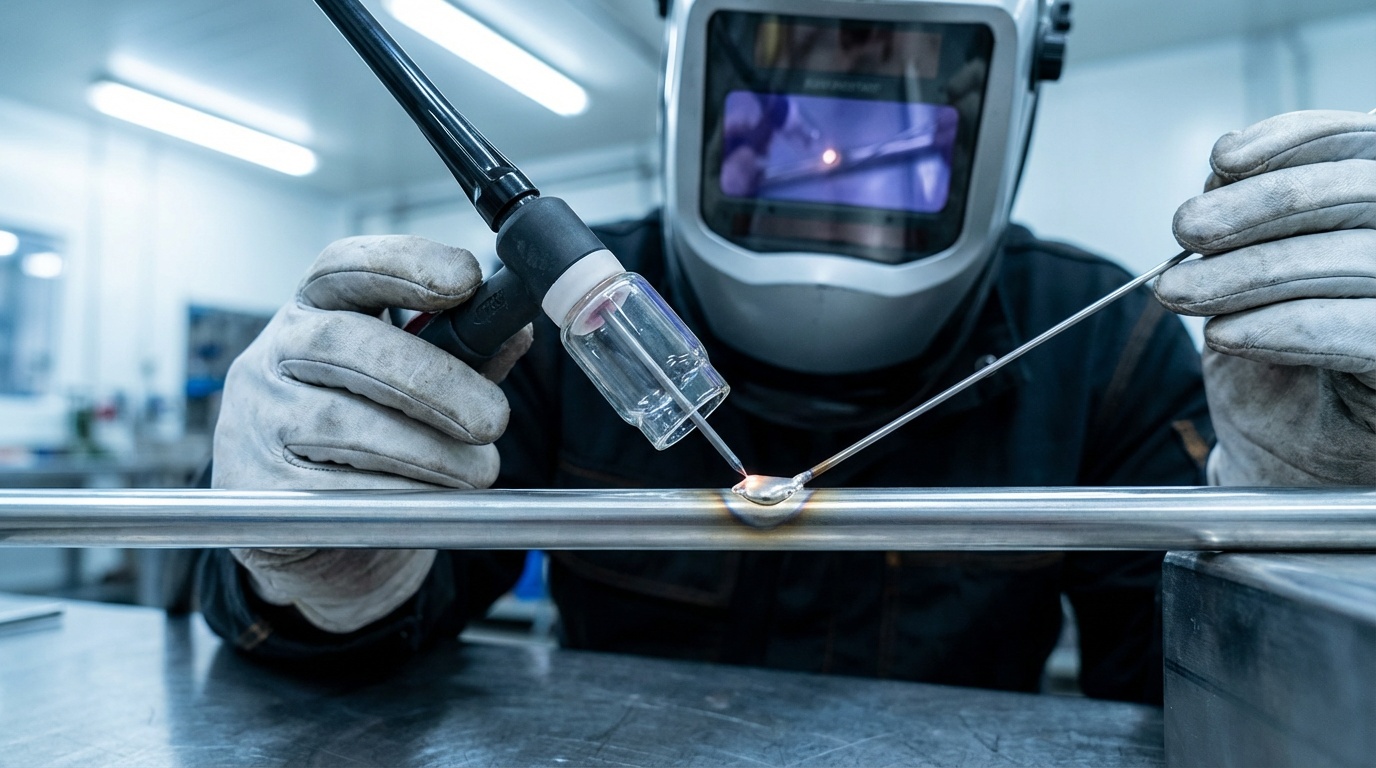
TIG vs MIG for Stainless: Which Should a Beginner Pick?
Mike sent me a photo of his first stainless project last month. A planter box for his deck. The welds looked like chewed gum — brown, burned, and the corners had warped like a potato chip. He'd used his MIG with 75/25 gas and ER70 wire, the exact same setup that lays down clean beads on mild steel.
Stainless doesn't care what works on mild steel.
Why stainless is picky
Stainless conducts heat differently than mild steel. It holds heat longer, warps easier, and discolors if you overdo it. Pick the wrong process and you'll spend more time grinding than welding. Pick the right one and stainless becomes the most fun metal to work with. Looks great. Holds up forever. Doesn't rust.
The good news: stainless is not harder than mild steel once you know the rules. You just need to actually follow them.
The short answer
Pick TIG if you care what it looks like.
Pick MIG if you care how fast it goes.
That's the real answer. TIG gives you pretty, clean, surgical welds on thin stainless — the kind you want on a custom railing, a tabletop grill, or anything people will actually look at. MIG gives you speed on heavier stuff, and with the right wire and gas it holds up fine. Neither is wrong. They just do different jobs.
When to pick TIG on stainless
TIG is the default on stainless in most shops for a reason. Here's when it's the right call:
Thin material. Anything under 1/8" — TIG lets you sneak in without burning through.
Cosmetic welds. Exposed corners, furniture, architectural work, food-grade stuff.
Tight spots. A TIG torch with a small cup fits where a MIG gun won't.
Thin tubing. Exhaust, handrails, fuel lines.
My usual setup for beginner stainless TIG: 2% lanthanated tungsten (blue or gold band — either is fine). 3/32" diameter for most stuff, ground to a point with a 2:1 taper. Filler: 308L for 304 stainless, 316L for marine or corrosive applications. Pure argon as your shield gas. Amps low — start around 1 amp per 0.001" of material, so 65–80 amps for 1/16" stainless.
When to pick MIG on stainless
MIG isn't a second-tier choice. It's the right tool when you need to move.
Thicker material — 3/16" and up.
Structural or hidden welds where looks don't matter.
Long runs where TIG would take you all day.
Production work.
The two things beginners mess up on stainless MIG: wire and gas. You cannot use ER70 wire. That's mild steel wire, and it'll contaminate your weld and kill the corrosion resistance you bought stainless for in the first place. Use 308L stainless wire for 304 base metal. Use 316L for 316.
And forget 75/25 argon/CO2. Use a tri-mix — 90% helium, 7.5% argon, 2.5% CO2 (sometimes sold as "stainless tri-mix"). If that's hard to find or too expensive at your supplier, 98/2 argon/CO2 works fine and it's easier to buy.
One more thing: run your MIG hotter on stainless than you do on mild steel. Stainless moves heat slower, so if you drop to mild-steel settings you'll get cold laps and no penetration.
The one thing beginners forget: heat management
Stainless warps. Stainless discolors. Both problems come from the same root cause — too much heat input.
On mild steel you can run a long continuous bead and move on with your day. On stainless you need to think like you're managing a fire. Short beads. Skip weld (1 inch on, 3 inches off, come back later). Let it cool between passes. Use a chill plate — a thick aluminum block clamped behind the joint pulls heat away and keeps your workpiece flat.
Watch the color of your finished bead. That color tells you how hot you ran.
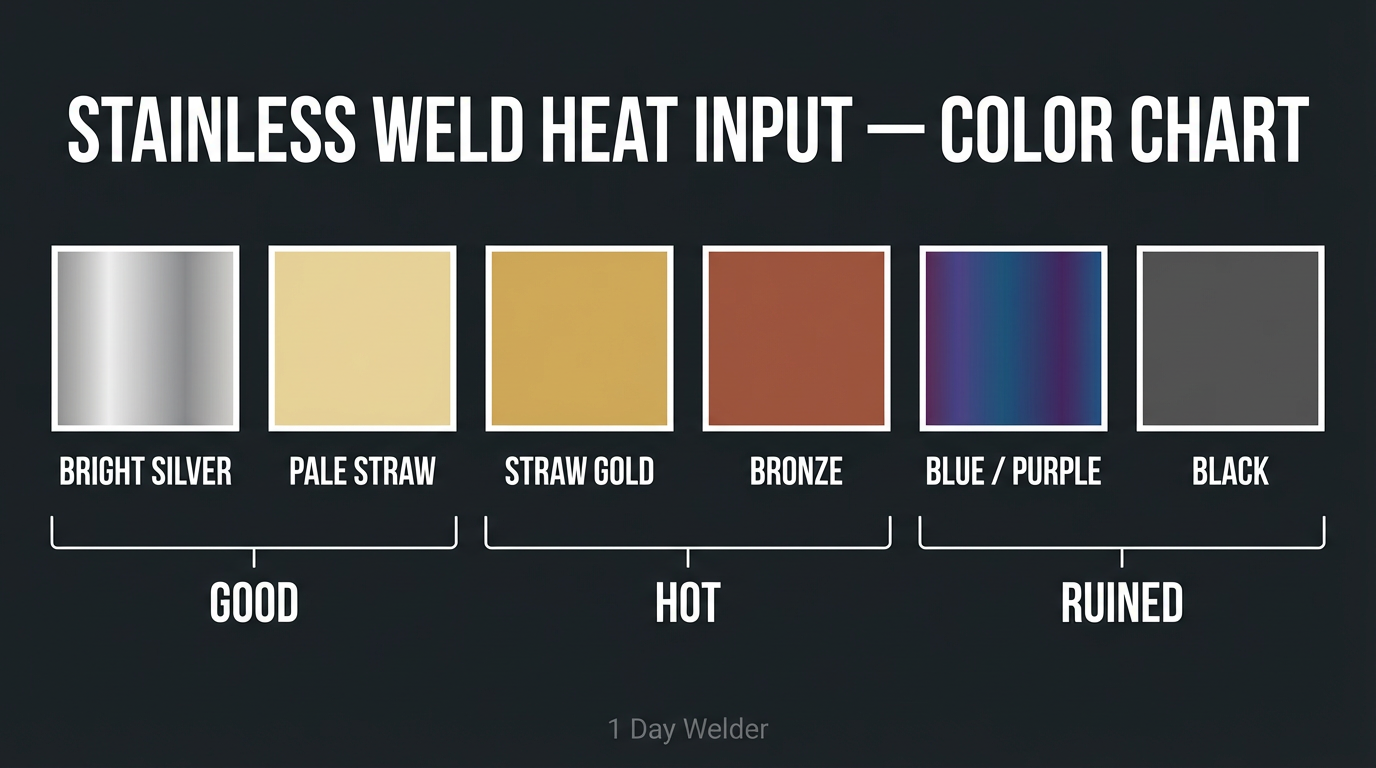
Silver to pale straw? You nailed it. Gold is getting warm. Bronze means too hot. Blue or purple means you cooked the chromium out of the surface, and that spot won't resist rust anymore. Black is done — grind it out and start over.
My recommendation for a beginner
If you only own a MIG and you want to try stainless, don't buy a new machine yet. Pick up a spool of 308L wire and a small bottle of tri-mix or 98/2. Run it on the machine you have. You'll be surprised what it can do.
If you're buying your first machine and you already know stainless is a big part of your plan, buy a multiprocess unit that does TIG. Something like the ESAB Rebel EMP 215ic or the AHP AlphaTIG 203Xi gives you both processes and you won't outgrow them for years. TIG takes longer to learn, but on thin stainless that extra control puts you in a different league.
Common mistakes beginners make
Using mild steel wire on stainless. Carbon from ER70 contaminates the weld, kills corrosion resistance, and looks like garbage. Use 308L or 316L.
Using 75/25 gas on stainless MIG. Too much CO2 dumps carbon in the puddle. Use tri-mix or 98/2.
Grinding stainless with a steel flap disc. The steel contamination causes rust spots weeks later. Use a dedicated stainless flap disc and mark it in sharpie so it doesn't wander.
Skipping the back purge on thin stainless tubing. The backside of the weld will "sugar" — turn porous and crumbly — if argon isn't flowing inside the tube. Tape the ends and run a purge line.
Welding too cold. Stainless needs more heat than you think. If your beads are stacking on top and not penetrating, turn it up.
Wrap it up
Stainless isn't as scary as it looks. It just doesn't forgive the same shortcuts mild steel does. Pick the right process for the job, use the right filler and gas, and manage your heat. Do those three things and you'll be laying down stainless welds people actually want to show off.
Join 30,000+ students learning to weld at home with my online course:
>>> Check out 1 Day Welder here
>>> Shop the 1 Day Welder Amazon Store
Talk soon,
Quinn "stainless is a picky" Morrissette